 English
 Français
 Deutsch
 Italiano
 日本語
日本語 Español

VusionGroup Unveils EdgeSense AI: Bringing Generative Intelligence Into Physical Retail
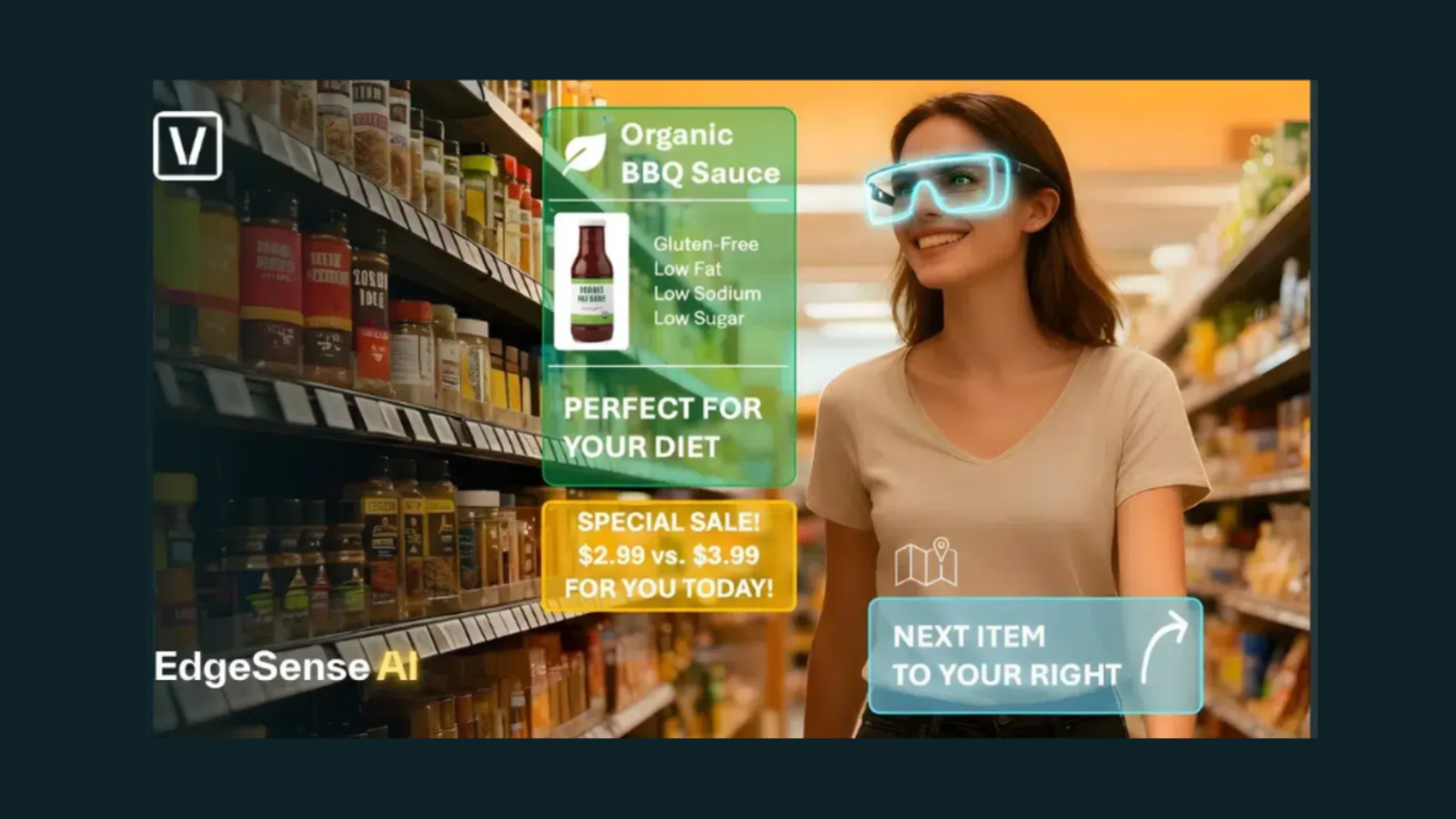
The EdgeSense Connected Store Platform is now open to Artificial Intelligence applications, turning physical stores into fully AI-native environments.
October 20, 2025 – VusionGroup, the global leader in digitalisation solutions for commerce, today announced the opening of its EdgeSense Connected Store Platform to AI applications and generative models, marking a major step toward bridging the digital and physical dimensions of commerce.
With this evolution, EdgeSense AI transforms thousands of connected stores into AI-native environments, where shelves, associates, and shoppers can interact through real-time spatial intelligence and conversational understanding.
By merging 3D locationing, computer vision, and natural language models, EdgeSense AI enables physical environments to sense, interpret, and respond dynamically to people and products — unlocking a new era of sensor-fused, GenAI-enhanced retail.
From Connected Stores to AI-Native Spaces
VusionGroup pioneered the digital transformation of retail with Electronic Shelf Labels (ESLs), bringing automation, pricing accuracy, and connectivity to the shelf edge. But ESLs were just the beginning. EdgeSense AI builds on this foundation, evolving the shelf from a passive display into an intelligent, interactive node in a living data network. What began as digital pricing infrastructure has now become a spatially aware platform capable of powering real-time AI experiences across the store.
E-commerce reinvented how people search; EdgeSense AI now redefines how they move, discover, and decide in real-world spaces. Through shelf-level sensing, edge computing, and AI-driven dialogue, stores can understand and anticipate needs in real time. A shopper can ask, “Where’s my favorite pasta?” and instantly receive personalized guidance to its exact shelf, discover related recipes, or unlock personalized offers.
“With EdgeSense AI, we are making the physical world natively intelligent,” said Roy Horgan, SEVP Strategy, Marketing & Communications at VusionGroup. “For years, AI has lived in the cloud. Today, it’s becoming spatial, embodied, and present — capable of understanding the context of every interaction inside the store.”
Why Only EdgeSense Can Make It Real
What makes this transformation possible — and unique to VusionGroup — is the living digital infrastructure that EdgeSense already provides at scale. Across more than 18 million connected rails and tens of millions digital shelf nodes already active in Europe, the Americas, and Asia-Pacific, EdgeSense forms the largest real-time spatial data network in retail — a constantly sensing and learning grid that connects every shelf, product, and interaction in 3D.
EdgeSense turns the store into a digital twin of itself — a spatially aware data environment where every shelf-edge node acts as a sensor and signal, continuously updating the store’s “live map.” This map becomes the context layer that Generative AI models, autonomous agents, and AI wearables need to understand and interact intelligently with the physical world.
EdgeSense is not a hardware system, but a real-time data platform — the missing link that connects the physical and digital worlds of retail. It gives AI models the ability to see, locate, and understand space with precision, enabling them to act and communicate in context.
Now with EdgeSense AI, VusionGroup is making this data and infrastructure available through APIs and developer partnerships — enabling new layers of contextual, generative, and ambient intelligence inside the physical world.
“EdgeSense gives AI the real-world context it’s been missing,” said Andreas Rössl, Group CTO of VusionGroup. “LLMs, smart glasses, and autonomous agents all need to understand where things are and what’s happening around them. EdgeSense provides that layer — a precise, living data grid for the physical world.”
As the era of AI wearables emerges — from smart glasses to ambient assistants and spatial computing devices — EdgeSense provides the geo-intelligence layer these technologies require to function meaningfully in the physical world. Just as GPS enabled smartphones to navigate and understand digital maps, EdgeSense provides the 3D spatial awareness and live data signals that enable AI-driven agents to operate inside physical environments.
For retailers, this represents the foundation of the AI-native store — where every object and interaction is part of a living, connected data ecosystem. Retailers that embrace this transformation will lead the way in delivering hyper-connected, intelligent experiences – where operations, engagement and personalization converge seamlessly.
A Shared Vision: Making the World Conversational
By combining EdgeSense’s spatial intelligence with Generative AI, VusionGroup envisions a future where any environment — not just stores — can become responsive and interactive. The company is opening collaborations for pilot projects with retailers, AI partners, research institutions, and smart device manufacturers starting Q4 2025.
FAQs
-
EdgeSense AI is the evolution of VusionGroup’s Connected Store Platform — now open to Artificial Intelligence applications.
It provides the spatial data, 3D context, and real-time connectivity that enable AI systems, wearables, and large language models (LLMs) to understand and operate intelligently inside physical environments.
-
EdgeSense is not just shelf technology — it’s a living digital infrastructure.
With over 18 million connected rails and tens of millions data nodes active across Europe, the Americas, and Asia-Pacific, EdgeSense forms the largest real-time spatial data network in retail. It continuously maps and connects every shelf, product, and interaction in 3D, turning each store into a spatially aware digital twin.
This foundation gives AI models and autonomous systems the context layer they need to see, locate, and understand the physical world.
-
Traditional ESLs were designed for a single purpose: automating price changes.
While they bring efficiency and accuracy to pricing, they lack the power, connectivity, and sensing capabilities needed for real-time spatial computing.
Each label operates independently, with limited data exchange and no unified spatial map.
As a result, standard ESL networks can’t support the continuous geolocation, computer vision, or contextual intelligence that AI applications require.
In contrast, EdgeSense creates a connected digital grid across the entire store — where every node becomes part of a coordinated spatial system capable of powering AI and next-generation in-store experiences.
-
EdgeSense goes far beyond price automation. It’s a fully integrated digital shelf system (DSS) that connects and powers a wide range of devices — from ESLs to sensors and micro-cameras — through a unified data backbone. Each shelf-edge node becomes both a sensor and a signal, continuously contributing to a 3D spatial model of the store.
This allows EdgeSense to deliver capabilities that ESLs never could, such as:
- Real-time product and shopper geolocation
- Computer vision integrated at shelf level
- Dynamic planogram and stock visibility
- Contextual connectivity with associates and shoppers via Bluetooth
- Data synchronization across AI systems, devices, and LLMs
-
ESL systems lack a shared spatial context. Because each label functions as an isolated endpoint, AI applications cannot know where a product physically is, whether it’s in stock, or how shoppers interact with it. Without a continuous flow of location and behavior data, Generative AI models and wearables have nothing to “see” or reason about in the real world.
By contrast, EdgeSense is a spatial data platform — every node contributes to a real-time, location-aware data fabric that AI can understand, analyze, and act upon.
-
Because EdgeSense already operates as a planet-scale, spatially aware data network. Its connected nodes act as data and location anchors for every product and shelf, creating a dynamic 3D “map” of the store that’s continuously refreshed. This live digital twin allows AI systems, wearables, and agents to operate in full context — responding to physical reality, not just digital prompts.
In short, ESLs digitize labels; EdgeSense digitizes space. That’s what makes EdgeSense the essential infrastructure for AI-native retail.
-
As smart glasses and ambient assistants enter retail environments, they need precise, continuous spatial data to function meaningfully. EdgeSense provides that layer — the equivalent of GPS for stores — enabling these devices to interpret surroundings, guide associates, and interact with products and customers in real time.
-
Retailers that adopt EdgeSense AI will lead the transition to hyper-connected, AI-native stores.
They’ll gain a unified data foundation that improves operations, enhances personalization, and opens new opportunities for AI-driven retail media and automation.
It’s not just an upgrade — it’s the infrastructure for the next era of intelligent commerce.
-
VusionGroup is opening EdgeSense APIs and developer partnerships for AI innovators, research institutions, and smart-device manufacturers starting Q4 2025.
This collaboration will fuel innovation in agentic commerce, in-store intelligence, and spatial computing — building the bridge between Generative AI and the physical world.
-
EdgeSense is already deployed across thousands of stores in Europe, the Americas, and Asia-Pacific. It continues to scale rapidly, establishing the foundation for a new generation of intelligent, responsive retail environments.