.png)
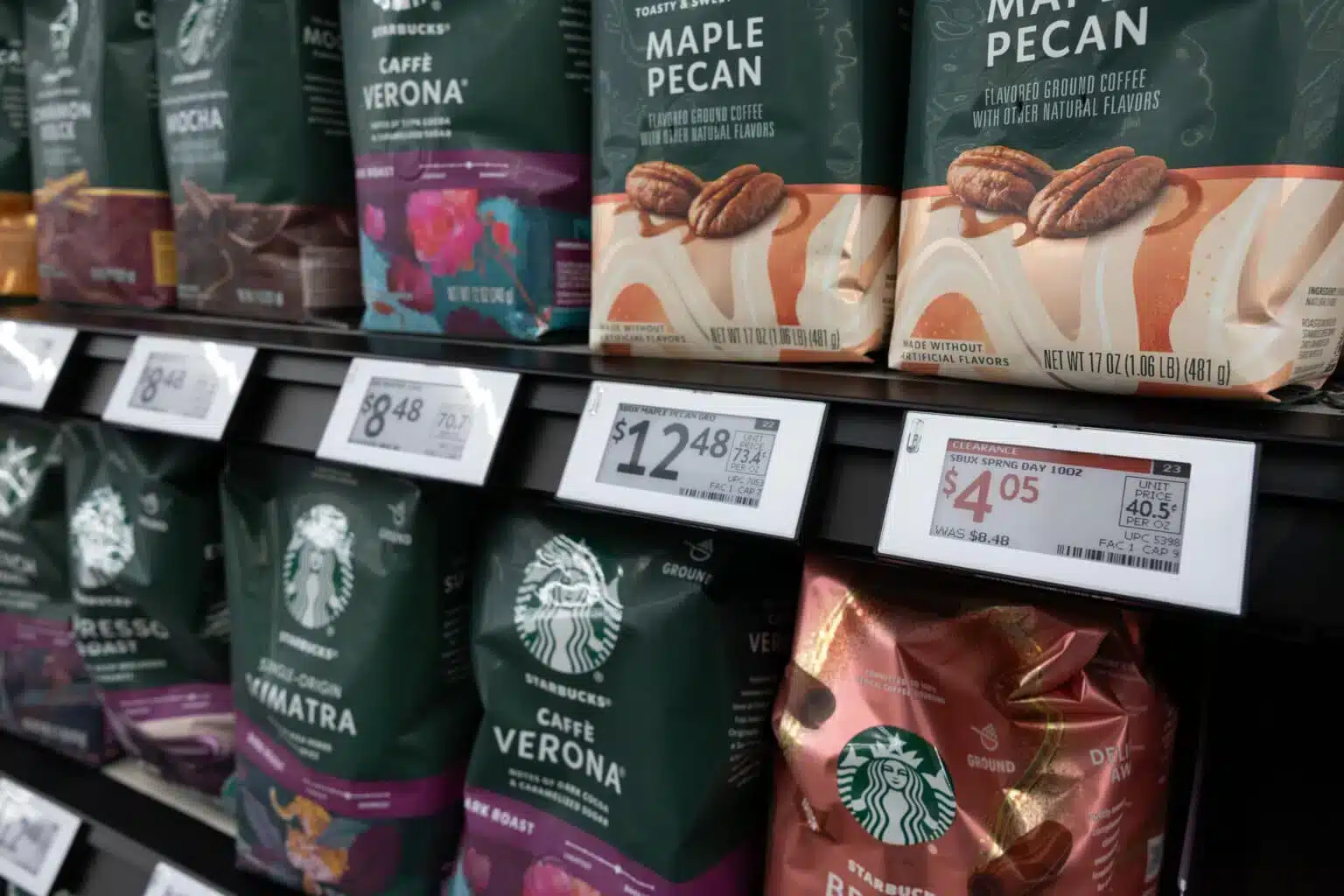
Can ESLs be used for purposes other than displaying prices, such as inventory management or assisting with order picking?
Absolutely! Beyond displaying prices, ESLs can enhance various retail operations:
- Inventory Management: Real-time stock levels and alerts.
- Order Picking: Assisting staff in locating products efficiently.
- In-Store Navigation: Guiding customers to product locations.
This multifunctionality contributes to streamlined operations for the store and improved service quality for the customers.
Who uses electronic shelf labels?
VusionGroup currently provides ESLs for retailers across multiple sectors, including:
- Grocery Stores and Supermarkets: For agile pricing and inventory management
- Department Stores: For consistent pricing across multiple departments
- Electronics Retailers: To provide detailed product specifications
- DIY and Home Improvement: For managing large product catalogs
- Appliance Stores: For displaying detailed product information
- Convenience Stores: For efficient price management
- Liquor and Beverage Stores: For pricing and promotions
Digital labels enhance operational efficiency and improve the customer experience in all these retail settings by making pricing displays more streamlined and interactive.
How are product prices and information updated on ESLs?
ESLs are managed through VusionCloud, a centralized dashboard system that gives retailers and store managers comprehensive control over all their electronic labels. Through this dashboard, they can seamlessly review and update pricing, promotions, and product details in real-time. These changes are then wirelessly transmitted to the ESLs throughout the store, ensuring immediate and accurate updates across all locations. Thanks to their advanced capabilities, ESLs can reliably adjust prices at the most critical times to boost sales and overall performance, all managed through this unified cloud platform.
Can ESLs display additional information, such as promotions or customer reviews?
Yes, ESLs can display a variety of information beyond pricing. This versatility enhances the shopping experience by delivering comprehensive product insights, including:
- Promotional Offers: Highlighting current deals and discounts.
- Customer Reviews: Showcasing ratings and feedback to assist in purchasing decisions.
- Nutritional Information: Providing detailed product content for informed choices
What are the key benefits of ESLs compared to traditional paper labels?
ESLs offer several advantages over paper labels:
- Real-Time Updates: Price variations and promotions are reflected instantly.
- Cost Efficiency: Costs associated with labor and material are reduced.
- Environmental Impact: Less paper waste, contributing to sustainability efforts.
Fewer Human-Related Issues: Mislabeling is a thing of the past.
These benefits lead to improved operational efficiency and a better customer experience.
Do ESLs function effectively in extreme environments, such as refrigerated or humid areas?
ESLs are designed to operate optimally in various retail environments, including areas with refrigeration or high humidity. Their robust construction ensures reliable performance under challenging conditions, maintaining accurate and visible displays. Waterproof models, such as the V300, can even be placed where fish, meat, or produce are displayed without compromising hygiene standards.
How reliable is the wireless network for ESLs in dense store environments?
Electronic shelf labels rely on a dedicated, low-bandwidth wireless protocol optimized for high-density retail environments. The infrastructure operates on isolated radio frequencies to avoid interference with Wi-Fi or other in-store systems. Advanced deployment planning includes site surveys to ensure full coverage—even in complex layouts. Once installed, the network supports stable, bidirectional communication across thousands of tags simultaneously, with uptime rates exceeding 99.9%. ESL platforms also include monitoring tools to detect and resolve any signal loss or coverage blind spots in real time.
What happens if an ESL display fails or the battery runs out?
ESLs are built for longevity, with a typical battery lifespan of over 5 years—even under intensive update cycles. When batteries near depletion, centralized platforms generate automated alerts to enable proactive replacement without service interruption. Labels are designed with fail-safe features: if a display glitch occurs, they retain the last valid price until reset. Combined with predictive maintenance and label-level diagnostics, this ensures uninterrupted pricing integrity and seamless store operations at scale.
Are ESLs readable and user-friendly for shoppers?
Absolutely. Modern ESLs are engineered for in-aisle clarity and usability. Their high-contrast e-paper displays are designed to remain legible from multiple angles and lighting conditions. Retailers can choose font sizes, icons, and layout templates to match shopper profiles and product types. Some ESLs also support QR codes or NFC taps to deliver expanded information, nutritional facts, or shopper reviews—enhancing transparency without cluttering shelves. These formats improve shelf navigation and reduce shopper frustration, especially in high-SKU environments.
Can ESLs trigger concerns around pricing fairness or trust?
Price consistency is a key benefit – not a threat – of ESLs. Rather than fueling suspicion, ESLs eliminate human error, synchronize prices across all channels, and display clear, updated information in real time. When integrated into a transparent pricing strategy, they reinforce customer trust by showing accurate promotions, unit prices, and expiry discounts. ESLs are always subject to centralized control and validation, ensuring that all price changes follow predefined business rules, without unexpected shifts at checkout. They deliver clarity, stability, and confidence at the shelf.
What infrastructure is needed to deploy ESLs in stores?
Deploying ESLs does not require heavy infrastructure. Stores need a power source for the communication access points and a reliable internet connection. The ESL system operates wirelessly and does not depend on the store’s Wi-Fi. Installation is fast – typically completed within 1 to 3 days per store, depending on store size – and includes a setup of a centralized content management system (CMS) to handle price updates and label configurations. The system integrates seamlessly with POS and ERP environments via API, without requiring major changes to existing workflows.
How do ESLs enable real-time promotions and pricing updates?
ESLs allow retailers to adjust prices and launch promotions instantly across the store network from a centralized platform. This agility means stores can synchronize promotional timing with marketing campaigns, react to competitor pricing, or manage inventory levels more strategically. ESLs eliminate manual ticket changes, ensuring consistency and speed at scale. Whether it’s a flash sale, end-of-day markdown, or regional pricing variation, ESLs deliver immediate execution, freeing store teams from labor-intensive tasks while improving responsiveness to market signals.
What types of electronic shelf labels are available?
Retailers can choose from a range of ESL formats to match different store environments and product categories. Standard monochrome labels are ideal for high-SKU areas like grocery, while color displays support branding and promotional visibility in non-food or specialty retail. Sizes vary from small-format labels for cosmetics or convenience stores to large-format models for bulk items or end caps. Some models integrate NFC or LED indicators, enabling shopper interaction or staff task management. All ESLs are designed to ensure readability, robustness, and low energy consumption.
How do electronic shelf labels support retail media and in-store advertising?
ESLs turn every shelf into a programmable advertising surface. Through scheduled content and contextual messaging, retailers can promote new products, highlight brand activations, or trigger targeted messages by daypart or location. QR codes or NFC taps allow shoppers to access digital coupons, branded videos, or online exclusives. Integrated into a retail media strategy, ESLs help monetize shelf space and deliver CPG campaigns with precision—right at the point of purchase. This creates a new revenue stream for retailers and boosts in-aisle brand visibility.
How are AI and IoT transforming electronic shelf label capabilities?
AI and IoT unlock new levels of intelligence for ESLs. Through AI-driven analytics, ESLs can display context-specific data, such as demand-driven price updates, stock alerts, or promotional recommendations. IoT connectivity allows ESLs to interact with shelf sensors, cameras, or inventory systems to detect gaps, confirm compliance, or trigger replenishment. This fusion turns each label into a smart node in a connected store ecosystem, enabling real-time decision-making and automated operations that align with shopper demand and supply dynamics.
How can ESLs reduce operational labor costs in retail stores?
By digitizing price updates, task management, and shelf execution, ESLs eliminate thousands of manual interventions per week. Store teams no longer need to print, cut, and replace paper labels, saving hours per employee and reducing pricing errors. Combined with features like pick-to-light or automated stock alerts, ESLs help prioritize store actions and accelerate routine tasks. This operational efficiency translates into lower labor costs, improved staff productivity, and higher consistency across store locations.
How do digital price tags enhance in-store customer experience?
Digital price tags provide real-time, transparent information that shoppers can trust. They reduce confusion caused by outdated paper tags, improve price visibility, and highlight promotions or loyalty discounts. Interactive features like NFC and QR codes give customers access to product reviews, availability data, or expanded content, bridging the online-offline gap. By empowering shoppers with accurate and engaging shelf-level information, ESLs enhance confidence, reduce friction, and support faster, more informed purchasing decisions.
How can electronic shelf labels improve pricing accuracy and compliance?
ESLs ensure that every price displayed on the shelf matches the central pricing system, eliminating discrepancies between checkout and shelf. This consistency strengthens compliance with pricing regulations and avoids customer complaints or penalties. ESLs also support automated audit trails and compliance reports, critical for retailers operating in regulated markets. By reducing manual updates, ESLs eliminate human error and enforce pricing discipline across every SKU, in every store.