.png)
- For customers with food allergies, accurate product information can be crucial to their health and safety.
- The United Kingdom’s Natasha’s Law demonstrates how a tragedy can lead to stronger expectations and requirements for clear, accessible allergen information.
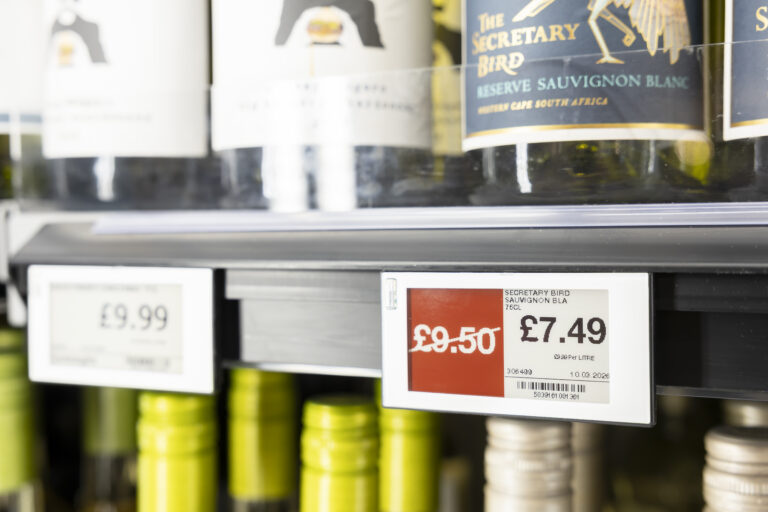
- Electronic shelf labels help retailers update and display important product information at the shelf edge.
- Digital shelf displays complement, but do not replace, information that regulations require on product packaging.
For millions of people living with food allergies, product information is not a convenience. It can determine whether an item is safe to buy.
For food made on the premises or pre-packed for sale, retailers have to make sure to keep product information accurate and clearly visible. Ingredients can change, suppliers be substituted and product ranges vary across stores, formats and seasons. When updates depend on printing, distributing and manually replacing paper labels, information can quickly become inconsistent or outdated.
In the United Kingdom, “Natasha’s Law” has required full ingredient and allergen labelling on food prepacked for direct sale (PPDS) since 1 October 2021, covering bakery items, sandwiches and salads packed in store. Keeping that information up to date across thousands of products, in hundreds of stores, is a significant operational challenge and one where manual processes carry real risk.
Electronic shelf labels (ESLs) allow retailers to display allergen and calorie information clearly and consistently at the shelf edge, updated centrally and reflected in store immediately, alongside price, weight and unit price.
What is Natasha’s Law?
Under Natasha’s Law, food that is packed on the premises where it is sold must carry a full ingredients list with the 14 regulated allergens emphasised.
Any food that is prepacked for direct sale must display the name of the food and a complete list of ingredients. Before the law enforcement, this information could be given by any means, including verbally by a colleague. That flexibility no longer applies to PPDS food.
The list of the regulated allergens is the following: celery, cereals containing gluten, crustaceans, eggs, fish, lupin, milk, molluscs, mustard, nuts, peanuts, sesame, soya, and sulphur dioxide and sulphites. All these must be emphasised among the ingredients, for example in bold, italics or a different colour, so a customer can identify them at a glance.
Separately from Natasha’s Law, large food businesses in England have been required since April 2022 to display calorie information on non-prepacked and PPDS food. For retailers, the practical effect is that a single shelf-edge display needs to carry several strands of mandatory and best-practice information at once.
What is Considered as PPDS?
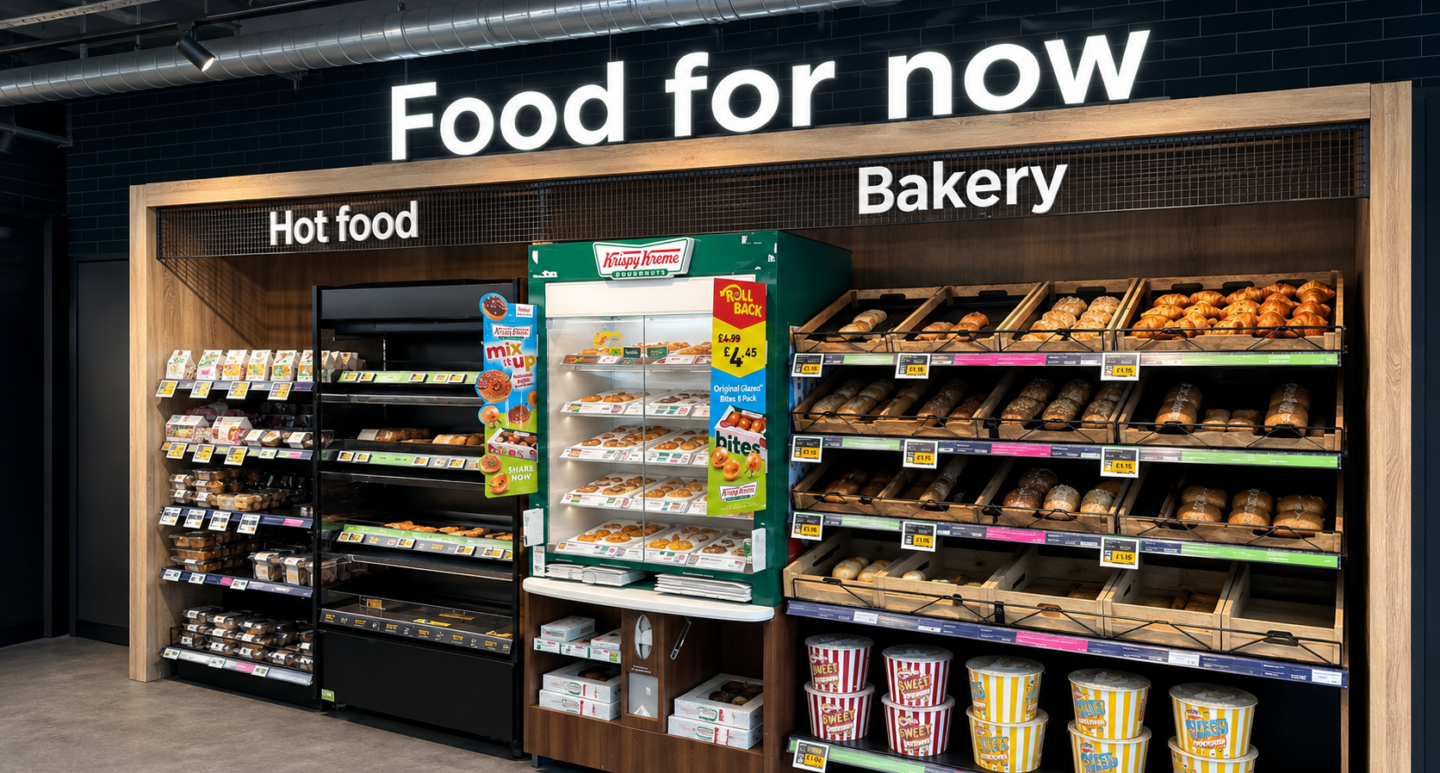
PPDS is food packaged at the same place it is offered or sold before the customer selects or orders it. In a grocery or convenience setting, that typically means in-store bakery items, sandwiches, wraps, salads and pasta pots.
How Does Natasha’s Law Affect Retailers?
The difficulty for retailers lies in maintaining the information at scale. A single convenience store may carry dozens of qualifying lines and a national estate several thousand, across different formats, ranges and seasons, and every reformulated recipe or substituted supplier has to be captured, checked and reflected on the shelf. Where that process depends on printing labels centrally, distributing them and replacing them by hand, it absorbs staff time and leaves room for error, with consequences in allergens that are more serious than in most other categories.
Bakery and food-to-go are the most exposed. They turn over quickly, can be reformulated regularly and are usually packed in store. They tend to be bought in a hurry by customers who may never speak to a member of staff.
Enforcement and Reputational Risk
Enforcement falls to local authority trading standards and environmental health teams, and breaches of food information law are criminal offences, though retailers generally feel the commercial effects of an allergen failure well before any legal process concludes.
Expectations have continued to tighten. In March 2025, the Food Standards Agency published best practice guidance recommending that written allergen information be available for non-prepacked food as a matter of course, supported by a conversation with staff. The guidance carries no legal force, but it sets out what the regulator now regards as adequate.
How ESLs Can Support Allergen Transparency and Store Teams
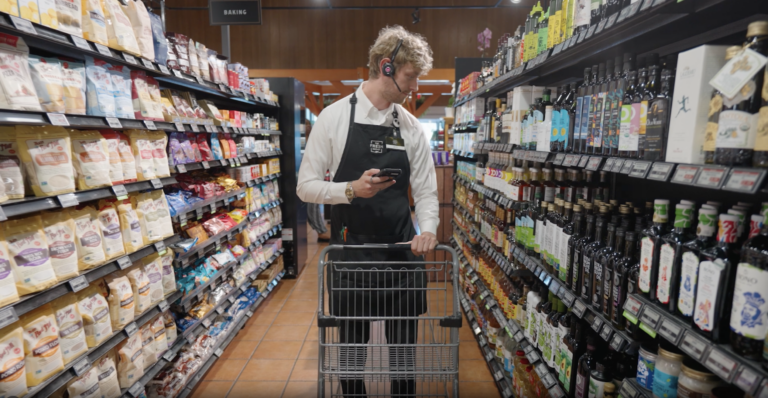
Electronic shelf labels, that are becoming more popular as British supermarkets have accelerated their digitalization over the past decade, draw what they display from a retailer’s central product record. A specification changed at head office appears on the shelf within minutes, without anything being printed or driven to a store, and staff spend correspondingly less time clipping tickets into rails and more on availability and service.
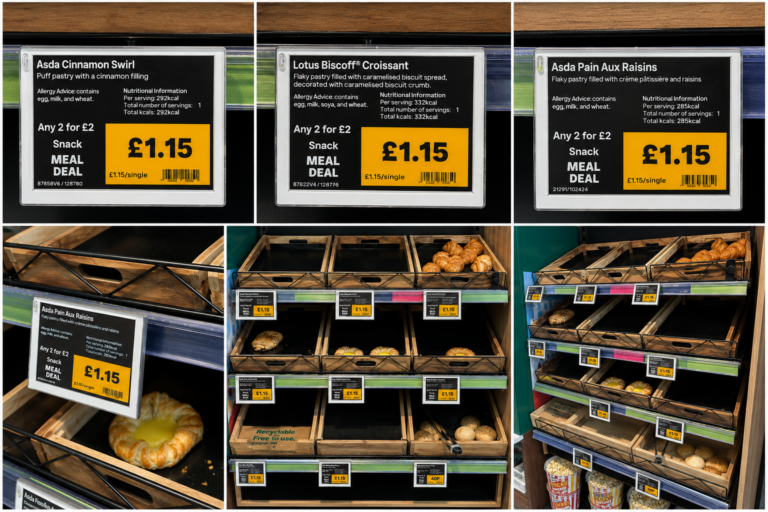
At the shelf edge, ESLs allow allergen and calorie information to sit alongside price, weight and unit price in a single, legible display, so a customer managing an allergy can find what they need where they are already looking. QR codes can carry the customer through to fuller product information where space at the shelf is limited.
The technology does not on its own satisfy Natasha’s Law, which requires the ingredients list to appear on the packaging or on a label attached to it, and a shelf-edge display sits alongside the product rather than on it. It does, however, put the information in front of customers before they reach for anything, which is aligning with the best practice guidance recommendations.
In Practice: Asda Express
Asda has launched allergen and calorie information for bakery products on Vusion ESLs across more than 150 of its Express convenience stores, extending a technology normally associated with pricing into an area of food safety law that has tightened considerably over the past five years.
The launch builds on the partnership announced in October 2025, under which Vusion’s digital solutions and ESLs are being deployed across 250 Asda Express stores, following a successful trial at Asda’s Oxford Road store in Manchester.
Tom Clark, Retail Operations Manager at Asda, said: “This is a brilliant demonstration of how technology can enhance both safety and efficient operations. We are proud to have partnered with Vusion to bring our customers better, clearer information at the shelf.”
Allergen Transparency Is Becoming an Operational Priority
The wider direction of travel suggests further change. The Food Standards Agency’s best practice guidance on non-prepacked food is due for review in September 2026, and the agency has spent the past two years pressing food businesses to put allergen information in writing rather than leaving it to a conversation at the counter. Retailers who have already digitised the shelf edge for pricing are in a better position to adapt to whatever follows and ensure the highest level of accuracy and compliance than those still working from printed labels.
For retailers, the task is to make allergen information accurate, clear and consistent across every product, every store and every update. For customers, the outcome should be simpler: the ability to pick something up and know what is in it.
The shelf edge is where that trust is either earned or lost.