.png)
- The Price Marking Order is the UK’s legislation that governs how retailers display pricing information to consumers. New reforms which came into effect on 6 April 2026 have now raised the bar for what is expected to be displayed on the shelf edge.
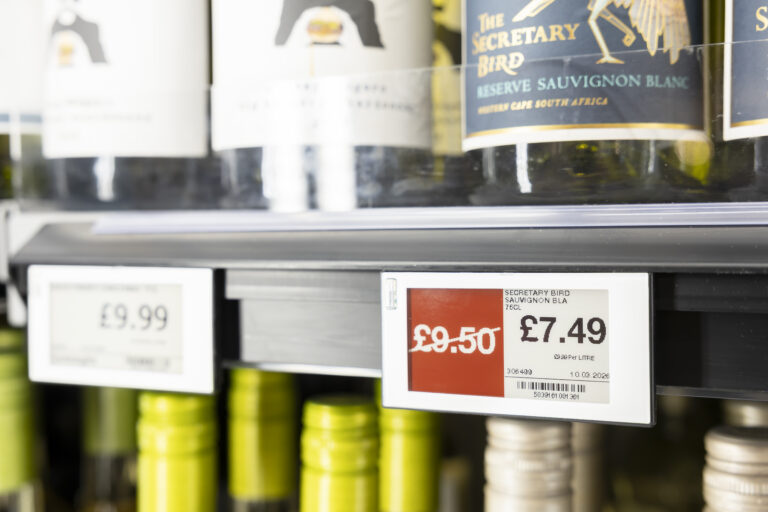
- Shelf labels must now clearly show selling, and where applicable, unit price in a standardised measure, with each price and its conditions shown where more than one price applies, which makes keeping pricing accurate and consistent a significant operational challenge for large retailers managing thousands of products.
- Electronic shelf labels (ESLs) offer a practical solution for retailers to ensure compliance and pricing transparency, while also supporting wider operations such as inventory management and order picking.
All major UK supermarkets are now required to comply with stricter rules on price displays. The changes form part of reforms to the UK’s Price Marking Order 2004, the legislation governing how product prices are presented to consumers both in-store and online. The updated requirements came into effect in April 2026 and are intended to improve pricing transparency, making it easier for shoppers to compare products and identify the best value for money.
For retailers, this change is not only a critical compliance update but also reflects a broader UK-wide focus on pricing transparency.
What does this mean?
Against a backdrop of inflation and increasingly price-conscious consumers, both regulators and shoppers are paying closer attention to pricing and promotions. As scrutiny of every basket grows, clear, accurate, and consistent shelf-edge pricing has become essential, not only for compliance, but also for building consumer trust.
What Information Does the Price Marking Order Require Retailers to Display?
Shelf labels must do more than show a headline price. They need to present clear information in a way that enables customers to understand the selling price, unit price and any applicable promotional or loyalty price.
Unit Price
The changes to the Price Marking Order requires retailers to display the selling price of individual goods. Where applicable, retailers must also display the unit price showing cost by a standard unit of measure, such as per kilogram, gram, litre, or cubic metre. Critically, retailers must now use one standardised metric for their pricing displays. The aim is to make pricing clearer, more consistent and easier for customers to compare.
Multiple Prices
Where a product is offered at more than one selling price, retailers need to ensure that the relevant selling and unit price information is clear, legible and not misleading.
Loyalty Offers
Loyalty schemes are now also included in the legislation. Discounts to the customers who have opted in their loyalty program must be dually displayed alongside non-loyalty prices.
Deposit Return Schemes
These reforms introduce updated definitions, including a requirement that deposits are excluded from the selling price and unit price and displayed separately where deposit return schemes apply. Deposit return schemes will launch on 1 October 2027 across England, Northern Ireland, Scotland, and Wales.
Discounts and Promotions
Where reductions apply, retailers must show both the reduced selling price and the reduced unit price.
As a summary, the price tags need to contain now the following information:
- Unit price
- Selling price
- Multiple price
- Loyalty offers
- Discounts and promotions
- Deposit return schemes
How Does the Price Marking Order Affect Retailers?
A New Operational Challenge
For supermarkets, this creates practical issues. Pricing information needs to be accurate, consistent and easy to understand at the shelf edge. That challenge becomes more significant in grocery, where products are frequently sold in different sizes, formats and pack configurations. It also needs to keep pace with frequent changes across promotions, loyalty pricing, reductions and central pricing systems.
Large supermarkets manage thousands of SKUs across multiple categories, store formats and promotional cycles. Manual price label changes are time-consuming and more vulnerable to error. A label that is out of date, inconsistent with the central pricing system or unclear to the shopper can create compliance risk and damage customer confidence.
Variations Across Store Sizes
The reforms do not apply in the same way to every retailer. Shops with a floor area not below 280 square metres are excluded from the requirement to display unit prices for pre-packaged products in constant quantities. The rules also allow for practical treatment of general reductions, such as broad percentage discounts, where changing every individual label may not be reasonably practicable.
For larger retailers, however, the message is clear: pricing transparency needs to be built into everyday store operations.
Fines and Penalties
Grocers in breach of the new rules could be fined up to 10% of their global turnover or £300,000 (whichever is higher). This would readily reach into billions of pounds for the UK’s largest grocers.
How ESLs can Support Compliance and Store Teams
For retailers focused on compliance, electronic shelf labels (ESLs) offer a practical solution to pricing transparency.
Pricing Integrity
ESLs can help retailers strengthen pricing integrity by ensuring the price displayed on the shelf is consistent with the retailer’s central pricing system and checkout. They support clear, legible displays and can help reduce discrepancies caused by outdated or inconsistent paper shelf labels.
Improve Customer and Associate Experiences
ESLs reinforce shopper confidence by improving clarity and consistency at the shelf. This is particularly important where prices change frequently, promotions are time-limited or loyalty pricing is applied across large parts of the store.
The benefit is not only regulatory. ESLs can also improve the colleague and associate experience. Store teams spend less time printing, sorting and replacing paper labels, and more time supporting customers, replenishing shelves and improving availability. Reducing manual label changes also reduces the risk of human error and helps teams manage pricing updates more efficiently.
Support Retail Operations
Beyond displaying prices, ESLs can support wider retail operations, including inventory management, order picking and in-store navigation. This multifunctionality contributes to more streamlined operations for the store and improved service quality for customers.
Pricing Transparency is Becoming an Operational Priority
The UK’s updated Price Marking Order requirements also reflect a broader shift in retail. Pricing has moved beyond a commercial or promotional decision, becoming a compliance, customer experience and store execution issue.
For supermarkets, the challenge is to make pricing information accurate, clear and consistent across every shelf, every store and every update. For shoppers, the outcome should be simpler: the ability to compare products more easily and buy with greater confidence.
For retailers, ESLs provide a practical way to meet that expectation. They help support compliance, improve pricing integrity and reduce operational pressure on store teams. In a market where transparency matters more than ever, the shelf edge has become a critical point of trust.
No. The Price Marking Order does not require a “was” price or the lowest or highest price from the past 30 days. That rule comes from EU law and does not apply in the UK.
Retailers can be fined up to £300,000 or 10% of global turnover, whichever is higher. The Competition and Markets Authority can now enforce the rules directly, without going to court, under the Digital Markets, Competition and Consumers Act.
They apply to any retailer selling goods to consumers in Great Britain, from large grocers to convenience stores, both in store and online. The one exception are small shops with a relevant floor area of less than 280 square metres. They do not have to show unit prices for products pre-packaged in constant quantities. Larger retailers have no such exemption, so the full requirements apply across their estate.