Mastering Digital Merchandising: How AI is Future-Proofing Retail
Digital merchandising strategies are evolving fast, with artificial intelligence (AI) driving seamless online and in-store experiences. Besides improving decision-making, AI is transforming retail operations and enhancing the end-to-end customer journey across digital platforms and physical stores, now and in the future.
At a Glance
- Merchandising is shifting from manual to machine-led. AI is now the driver.
- Predictive algorithms help cut the $1.7T cost of inventory distortion (Source : IHL Group).
- Real-time insights power smarter assortments, pricing, and shelf execution.
- Retailers like The Fresh Market and Walmart are setting the pace with AI.
- VusionGroup makes this shift actionable, with ready-to-deploy AI that drives ROI, fast.
Merchandising Is No Longer Guesswork,It’s Data-Driven
Historical trends and intuition have no place in digital merchandising strategies. With rich data filtering throughout retail enterprises, planners now leverage real-time shopper data to personalize product recommendations and increase ecommerce relevance. By using predictive analytics and retail data visualization, planners fine-tune product experiences and category strategies with precision and optimize assortments based on ecommerce sales data and shopper insights. Armed with this knowledge, retailers are primed to eliminate assortment redundancy, errors and out-of-stocks, details which could save the retail industry approximately $1.7 trillion annually, according to IHL Group.
Why AI Is Now Central to Every Retail Merchandising Strategy
With AI entering the retail mainstream, merchandising is no longer reactive, it’s predictive. Here’s how data-driven strategies are reshaping the way planners build, execute, and optimize assortments.
Moving Beyond Intuition: Real-Time Decisions at Scale
As big data continues to grow at an exponential compounded annual rate of 13.5%, according to global research firm The Insight Partners, retailers must analyze their ever-expanding information in new ways. By adding AI to the mix, merchandisers are evolving their ecommerce merchandising capabilities, and future-proofing planning strategies.
The Cost of Inaction: $1.7 Trillion in Lost Revenue from Inventory Distortion
AI algorithms “learn” from every analysis completed. As a result, retailers can expertly predict customer preferences and use this information to automate in-store merchandising, refine shelf strategies, ensure accurate product availability and personalize shopper experiences, all of which ultimately increase efficiency, improve customer satisfaction, conversion rates and drive higher revenue.
In fact, 46% of companies using AI solutions for inventory management are reducing operating costs. Specifically, 15% of these companies have reduced expenses between 10% and 20%, according to “The State of AI: How Organizations are Rewiring to Capture Value,” a report from McKinsey & Co.
AI’s Impact on Efficiency, Waste Reduction and Margin Gains
And it has never been easier to access AI solutions. With real-time dashboards, retail managers access ecommerce and in-store metrics, track performance, and adjust on the fly.
How Retailers Use AI to Optimize the Full Merchandising Cycle
AI doesn’t just improve planning, it transforms every step of the merchandising cycle, from forecasting to execution. Here’s how leading retailers are putting intelligence to work at the shelf level.
Smarter Assortments and Localized Planning
These portals also enable planners to immediately and accurately forecast demand, manage ecommerce inventory, and tailor assortments to shopper behavior. Merchandisers can also seamlessly test tailored product assortments by geography, store type and shopper behavior. Portal-delivered results highlight which assortments drive the highest levels of efficiency and revenue.
Shelf-Level Execution Powered by Computer Vision
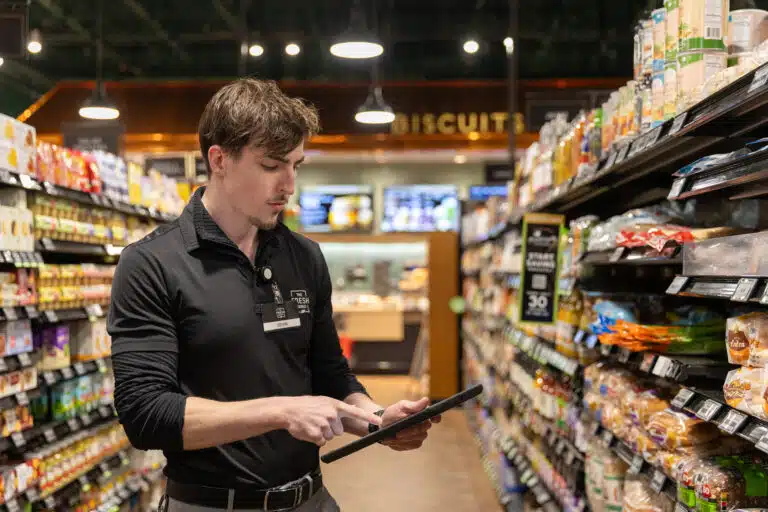
The Fresh Market uses VusionGroup-powered AI-enabled mobile devices for visibility into every store shelf and product, including center store and fresh departments. Users can digitally detect out-of-stocks, prioritize shelf replenishment and revise merchandising decisions on the fly. Additionally, VusionGroup’s AI enables the Greensboro, N.C.-based grocer to monitor fresh food availability, produce displays and reduce general waste.
Demand Forecasting and Real-Time Personalization
The Fresh Market is not alone in its AI confidence, as 72% of merchants are also optimistic about the technology’s potential direct impact on merchandising, according to a study from Boston Consulting Group.
Case Studies: What Retailers Like The Fresh Market and Walmart Are Doing Right
From real-time price updates to automated shelf replenishment, retailers like The Fresh Market and Walmart are already seeing measurable gains from AI-powered merchandising. Let’s look at what they’re doing differently, and why it works.
From Price Automation to Shelf Replenishment
AI is also becoming the “great integrator” among retailers’ enterprise planning ecosystems. Powered by application programming interfaces (APIs), AI seamlessly integrates into companies’ existing merchandising applications, including cloud-based data lakes and every digital solution collecting rich customer data.
ESLs and IoT in Action: Speed, Accuracy and Scale
Electronic shelf labels (ESLs) are one of these solutions. The devices digitally collect real-time data including customer interactions, product details, promotions and inventory levels, then wirelessly transmit information to the cloud. Here, AI algorithms analyze data to identify trends and predict shopper behavior, factors required to optimize merchandising and tailor pricing strategies.
VusionGroup-Powered Stores: Toward Real-Time Merchandising Excellence
Walmart, which updates prices weekly on more than 120,000 new items, rollbacks and markdowns, added ESLs on the EdgeSense digital shelf system in 500 stores last year to manage pricing, inventory and order fulfillment. Leveraging the ESLs to digitally update prices via a mobile app, users slashed price change timing from two days to mere minutes. The project was so successful that the Bentonville, Ark-based behemoth plans to expand ESLs across its entire 4,600-store fleet in the United States.
Transform Merchandising with VusionGroup’s AI-Powered Solutions
VusionGroup brings AI out of theory and into stores with solutions designed for speed, ecommerce scalability, and measurable retail impact. Here’s how.
Ready-to-Deploy Technologies That Drive ROI Fast
Bottom Line
The shift from instinct-driven decision-making to data-led merchandising strategies empowers retailers to be more agile, responsive and accurate. As planners future-proof their merchandising operations however, more companies will position AI at the core of their ecommerce and in-store strategies.
Start with a Pilot: One Store, One Category, 90 Days
Designed for real-time insight and immediate action, AI will enable planners to move beyond predictions and create automated enterprise merchandising solutions that continuously learn from customer demand. A key integrator among enterprise solutions and smart devices, AI will also enable retailers to dive deeper into customer preferences and shopping patterns, a move that will heighten demand forecasting, uncover new growth opportunities, operational efficiencies and create value for their employees and shoppers.
VusionGroup is working on deploying the most impactful elements of AI into its technology to help retailers do their jobs better at every shopper touchpoint. Contact us HERE to learn more.
FAQs
What is digital merchandising in retail?
Digital merchandising refers to the use of technology and data to manage how products are displayed, priced, and promoted across physical and digital stores. It includes tools like electronic shelf labels, planogram automation, and AI-driven assortment planning.
How does AI improve merchandising efficiency?
AI helps retailers forecast demand, automate pricing and promotions, detect shelf gaps, and personalize assortments based on real-time data. This reduces manual tasks, cuts costs, and improves in-store execution.
What’s the ROI of AI in merchandising?
Retailers using AI for inventory and merchandising see reductions in stock distortion costs—up to $1.7 trillion globally. They also report faster decision-making, improved margins, and fewer out-of-stocks (Source : IHL Group, McKinsey).
Can AI be integrated into existing retail systems?
Yes. VusionGroup’s AI solutions integrate seamlessly via APIs into merchandising, inventory, and pricing platforms. They centralize data flows and eliminate silos, enabling real-time collaboration across teams.
What’s the first step to implement AI in-store?
Start with a pilot. Choose one category or store. Measure performance, optimize based on real-time data, then scale. VusionGroup supports rapid deployment and results within 90 days.